
Regulation Confers Persistence
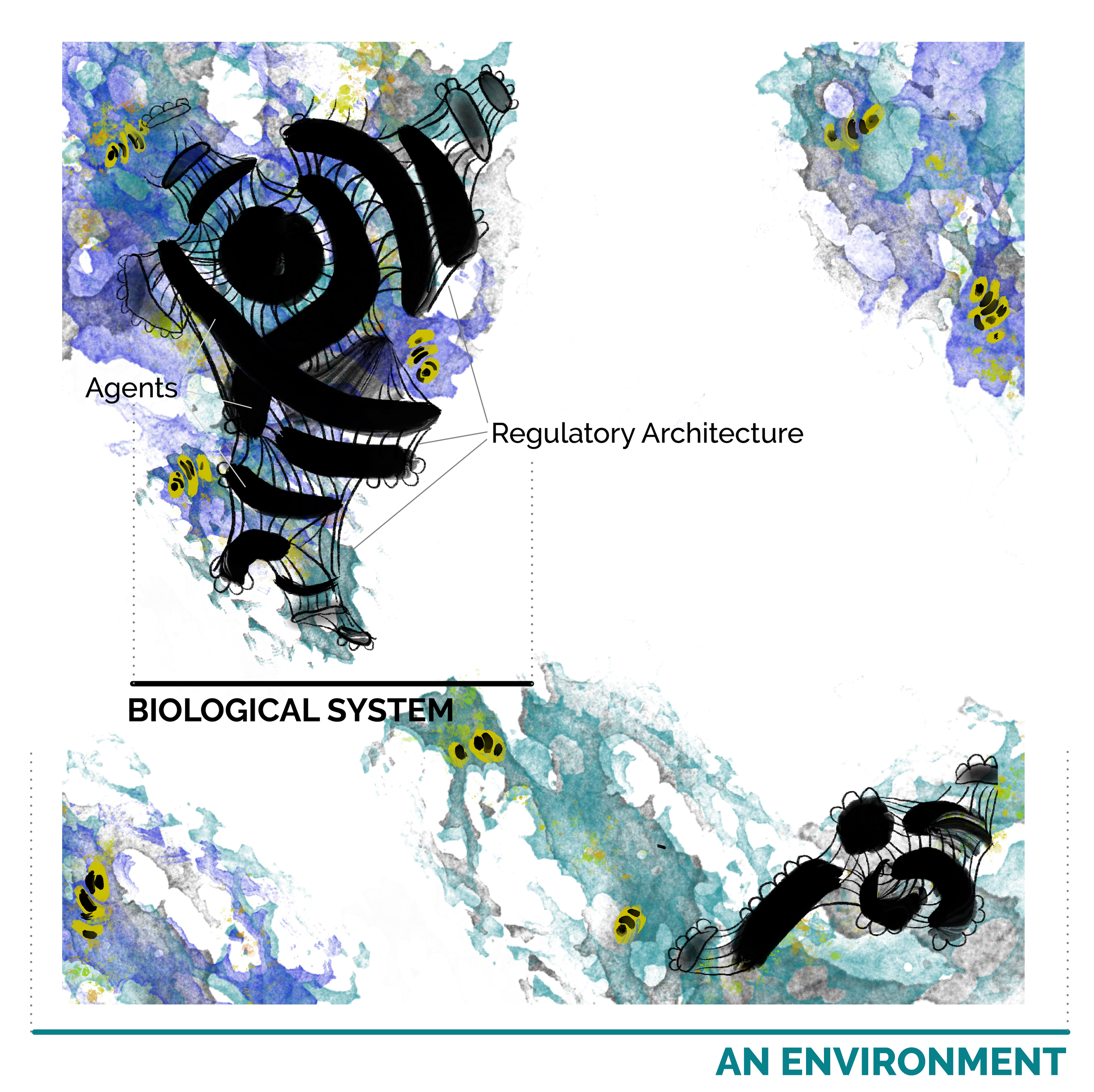
Biology comprises systems made up of agents whose goals are to thrive and survive. Those that thrive in stable times will be the most dominant component of that population—but what if times are not so stable?
Environments can be variable, and biology is notoriously random and unpredictable: heat shock, ecological competition, and starvation all cause perturbation to biological systems. In challenging times, conventionally adaptive strategies fail, and alternate programming is required that allow for flexible survival strategies. These strategies are the product of regulation and the architectures that make regulation possible.
Regulatory Paradigms Across Scales
Regulatory architectures comprise the agents and processes responsible for system persistence. These architectures are composed of code and regulators: the code stores the programs of regulatory function, while the regulators are the agents that carry out the encoded programs. Regulatory architectures exist across all scales of biological systems and therefore life, from proteins in the simplest bacteria to the bureaucracies that govern societies.
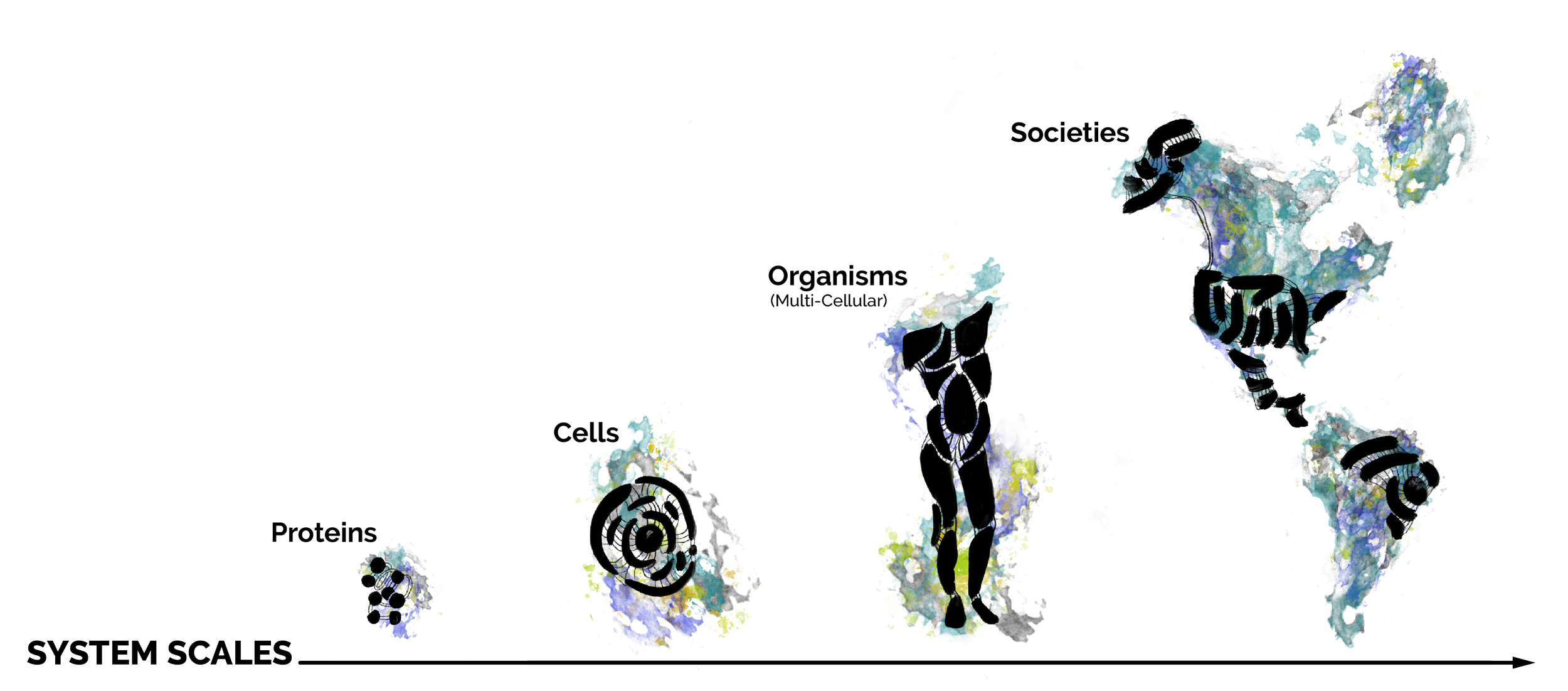
Inside cells, transcription factors act to coordinate gene expression, leading to distinct expression states and cell types. In multicellular organisms, brains and nervous systems coordinate organs and appendages to achieve desired physiological outcomes. In society, laws passed from centralized institutions—from the laws of sport to legal codes—ensure that people interact in fair, useful, and respectful ways, resulting in institutional success.
Regulation is a cost—paid in cellular resources, metabolic energy, administrative labor, or taxpayer dollars—but enables systems to maintain coordinated function despite internal and external perturbations. To regulate is to facilitate stability and robustness, allowing a complex system to persist.
Bridging Regulatory Paradigms
How far can a cross-system analogy go? What are the principles underlying a Science of Regulation that spans the tree of life? The goal of the Regulation, Randomness, and Robustness (R3) Lab is to develop a Science of Regulation across domains in the physical, biological, and social sciences. The Lab approaches this through three interconnected questions:
How do regulatory architectures evolve?

How does regulation deal with randomness, both internally and externally?
How does persistence drive the evolution of system robustness?